
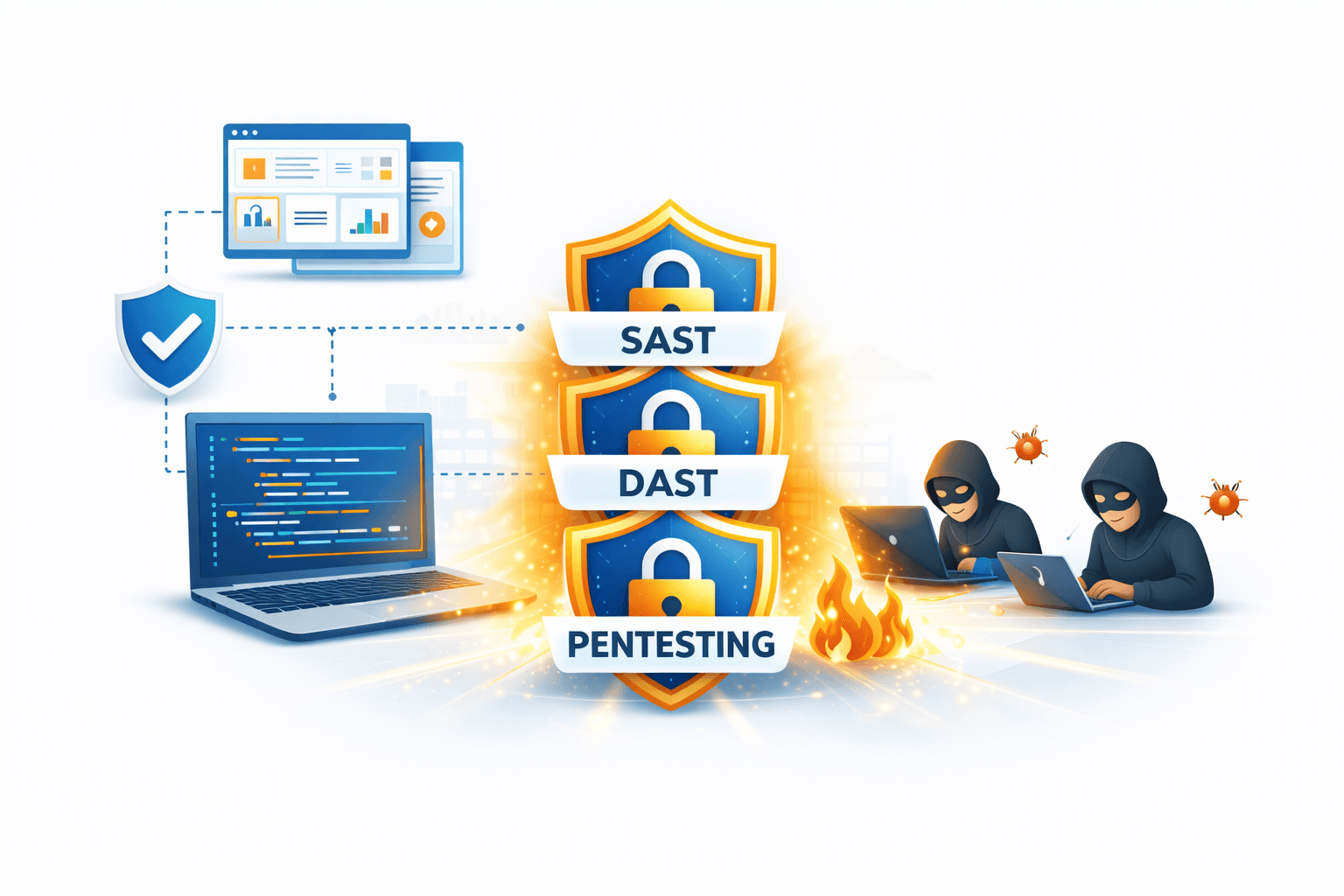
"A complete application security testing guide explaining SAST vs DAST vs penetration testing. Learn how each works, key differences, tools, use cases, and how to integrate them into DevSecOps."
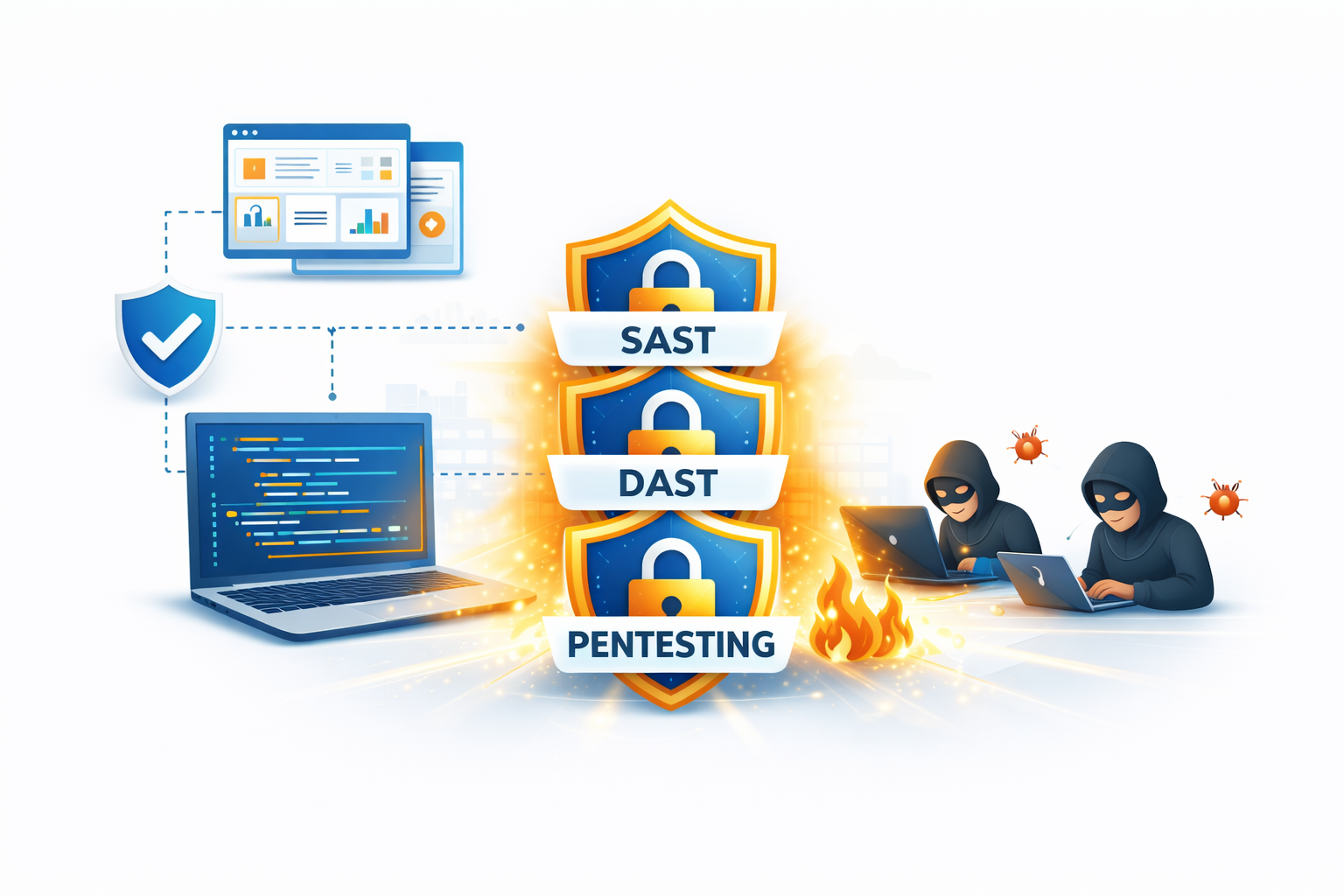
As applications become more complex—microservices, APIs, cloud-native platforms—the attack surface grows exponentially. Traditional perimeter security (firewalls, WAFs, network rules) is no longer enough.
Most modern breaches happen inside the application layer, exploiting insecure code, broken authentication, exposed APIs, and flawed business logic.
This is where Application Security Testing (AST) becomes critical.
In this in-depth guide, we will deeply explain:
What Application Security Testing really means
How SAST, DAST, and Penetration Testing work internally
Their strengths, limitations, and real-world use cases
How enterprises should combine them for production-grade security
This guide is written for developers, DevOps engineers, security teams, architects, and CISOs.
What Is Application Security Testing (AST)?
Application Security Testing (AST) is the process of identifying, validating, and mitigating security vulnerabilities within an application itself, rather than its underlying infrastructure.
AST focuses on:
How the application is written
How it processes input
How it authenticates users
How it authorizes actions
How it behaves at runtime
Unlike infrastructure vulnerabilities, application vulnerabilities are unique to your code—and attackers actively look for them.
Why Application Security Testing Is Non-Negotiable
According to OWASP, application-layer vulnerabilities such as injection attacks, broken access control, and insecure APIs dominate real-world breach incidents.
Why Apps Are Targeted:
Applications expose business logic
APIs are internet-facing
Developers prioritize speed over security
Vulnerabilities are reusable across deployments
Even the most secure cloud environment cannot protect a vulnerable application
Understanding the Three Pillars of AppSec
Application security testing is generally divided into three complementary approaches:
SAST – Analyze the code
DAST – Attack the running application
Penetration Testing – Think like a real attacker
Each answers a different security question.
SAST – Static Application Security Testing (Deep Explanation)
What Is SAST?
Static Application Security Testing (SAST) examines application source code, bytecode, or binaries without executing the application.
It is called static because the application is not running during analysis.
How SAST Works Internally
Parses source code into abstract syntax trees (ASTs)
Tracks data flows from input to sink
Identifies insecure coding patterns
Maps findings to known vulnerability classes
Produces detailed reports with file paths and line numbers
SAST tools essentially read your code the way a compiler does—plus security logic.
Types of Vulnerabilities SAST Excels At
SQL Injection (code-level)
Command injection
Hardcoded credentials
Insecure cryptographic usage
Unsafe deserialization
Missing input validation
Why SAST Is Critical in DevSecOps
SAST enables shift-left security, meaning vulnerabilities are caught:
Before deployment
Before reaching production
While developers still remember the code
Benefits:
Faster remediation
Lower cost to fix
No runtime environment needed
Limitations of SAST (Reality Check)
High false positives
Cannot confirm exploitability
Struggles with runtime configuration
Limited understanding of business logic
📌 Important: SAST finds potential vulnerabilities, not guaranteed exploits.
When to Use SAST
✔ On every code commit
✔ In CI/CD pipelines
✔ During pull request reviews
DAST – Dynamic Application Security Testing (Deep Explanation)
What Is DAST?
Dynamic Application Security Testing (DAST) analyzes an application while it is running, exactly as an attacker would—from the outside.
DAST does not require source code access.
How DAST Works Internally
Discovers application endpoints
Crawls pages and APIs
Injects malicious payloads
Observes application responses
Confirms whether vulnerabilities are exploitable
DAST focuses on behavior, not code.
Types of Vulnerabilities DAST Finds Best
Cross-Site Scripting (XSS)
SQL Injection (runtime)
Authentication flaws
Session management issues
API security vulnerabilities
Server misconfigurations
Strengths of DAST
Very realistic attack simulation
Lower false positives than SAST
Identifies runtime misconfigurations
Language-agnostic
Limitations of DAST
Requires a deployed environment
Slower than SAST
Limited coverage of hidden logic
Cannot see backend source code
When to Use DAST
✔ On staging/UAT environments
✔ Before production releases
✔ On live production (read-only mode)
Penetration Testing – The Human Intelligence Layer
What Is Penetration Testing?
Penetration Testing is a manual, expert-driven security assessment that mimics real-world attackers.
Unlike automated tools, pentesters:
Chain vulnerabilities
Abuse logic
Think creatively
Adapt to defenses
How Penetration Testing Works (Step-by-Step)
Reconnaissance and asset discovery
Threat modeling
Manual exploitation
Privilege escalation
Business impact analysis
Proof-of-concept creation
Executive-level reporting
What Pentesting Finds That Tools Cannot
Business logic flaws
Authorization bypass
API abuse patterns
Multi-step attack chains
Zero-day-style weaknesses
Why Pentesting Is Still Essential
Automation cannot replace:
Human creativity
Context understanding
Business abuse scenarios
Pentesting answers the question:
“If I were a real attacker, how far could I go?”
Limitations of Pentesting
Expensive
Not continuous
Point-in-time assessment
Requires skilled professionals

How Enterprises Should Combine All Three
🔐 A Mature AppSec Strategy
SAST – Every commit (developer-owned)
DAST – Every release (security-owned)
Pentesting – Quarterly or major changes
This creates layered security coverage.
Application Security Testing in a DevSecOps Pipeline
Example Flow:
Pre-commit: SAST
Build: Dependency scanning
Deploy to staging: DAST
Pre-production: Pentesting
Production: Runtime monitoring
Security becomes continuous, automated, and measurable.
Common Misconceptions
❌ “DAST replaces pentesting”
❌ “SAST slows developers”
❌ “Security tools are enough”
✅ Truth: Security is a process, not a tool
Conclusion
SAST, DAST, and Penetration Testing are not alternatives—they are layers of defense.
SAST protects your code
DAST protects your running app
Pentesting protects your business logic
Organizations that combine all three build resilient, breach-resistant applications.
Secure applications aren’t achieved by testing once—but by testing continuously and intelligently.