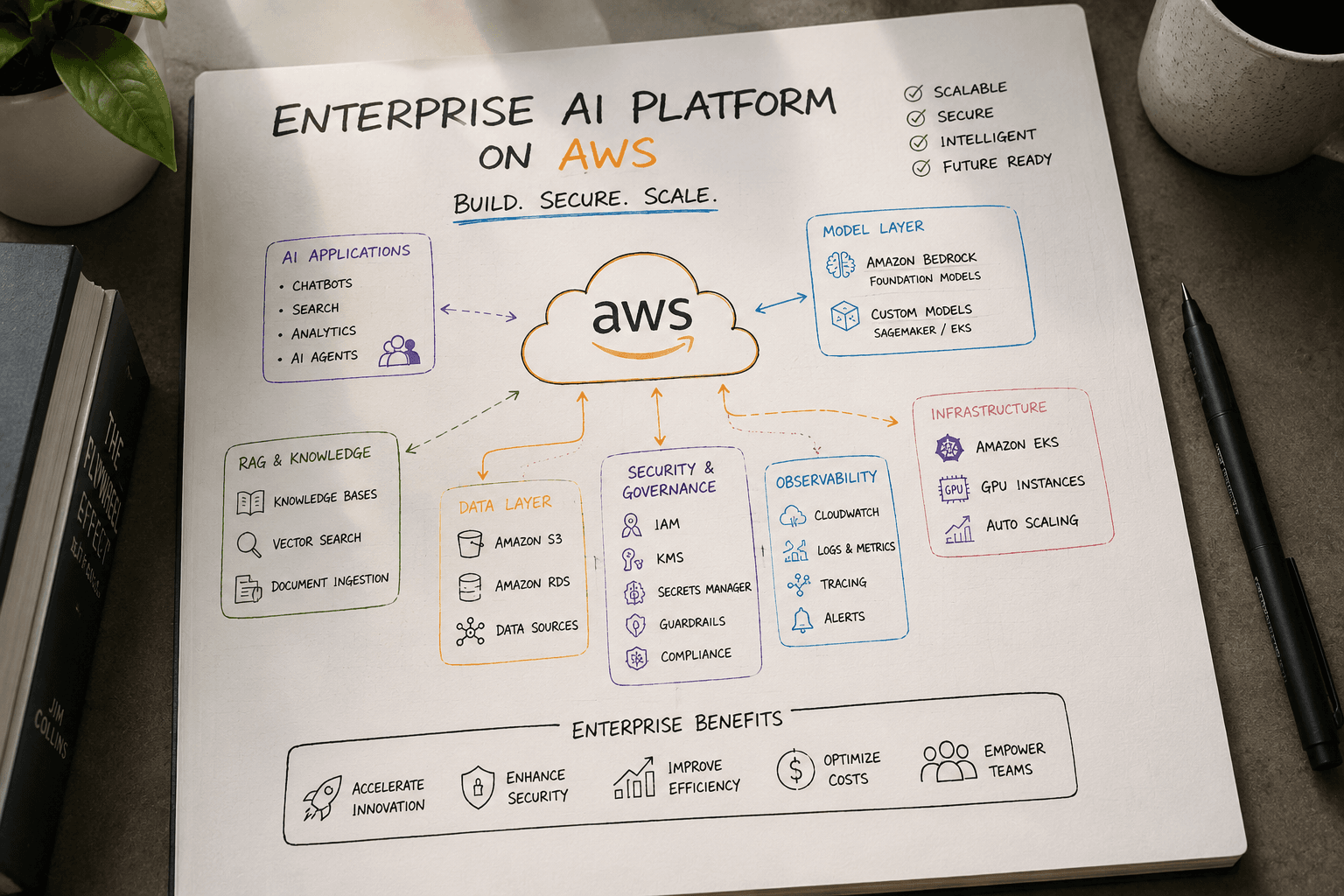
"Learn how to build an enterprise AI platform on AWS using Amazon Bedrock, Amazon EKS, RAG, secure networking, IAM, model infrastructure, observability, governance, and cost optimization. Discover how to design a scalable AI platform for production workloads."
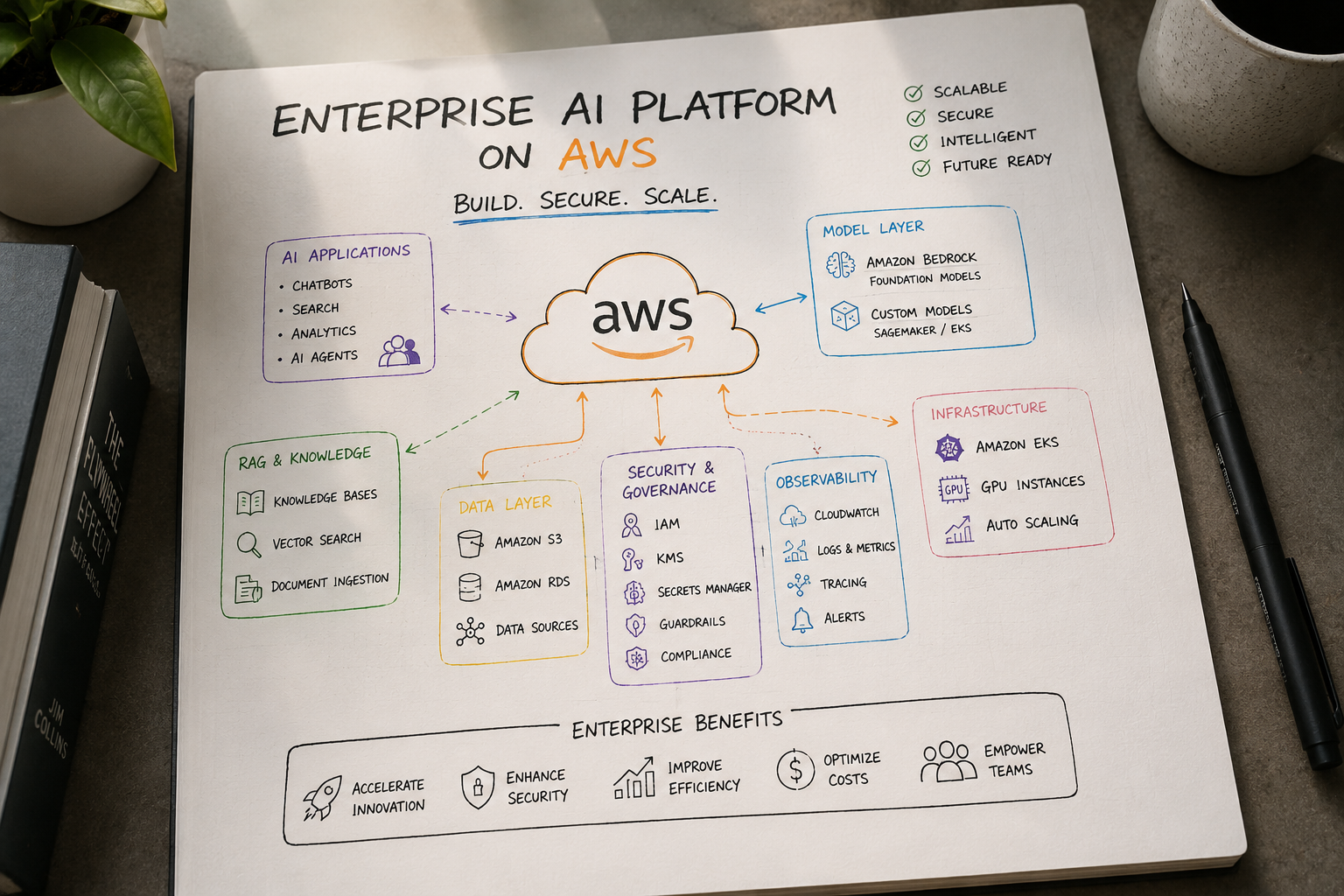
How to Build an Enterprise AI Platform on AWS
Artificial intelligence is moving from experimental projects into core enterprise applications.
Organizations are using AI for:
Customer support
Internal knowledge assistants
Document analysis
Code generation
Business intelligence
Financial analysis
Marketing automation
Intelligent search
Workflow automation
AI agents
Enterprise decision support
However, building one AI application is very different from building an enterprise AI platform.
An enterprise platform needs to support multiple teams, applications, models, datasets, security requirements, governance policies, and workloads.
A production AI platform therefore needs to answer questions such as:
How will applications access AI models?

How will enterprise data be connected to AI?

How will users be authenticated?

How will sensitive data be protected?

How will different teams share the platform?

How will models be monitored?

How will AI workloads scale?

How will costs be controlled?

How will AI usage be governed?
AWS provides a broad set of services that can be combined to build this type of platform.
A modern architecture can include:
Amazon Bedrock
Amazon EKS
Amazon S3
Amazon OpenSearch
Amazon RDS
AWS IAM
AWS KMS
AWS Secrets Manager
Amazon CloudWatch
AWS WAF
Amazon API Gateway
Terraform
CI/CD
The exact combination depends on the organization's requirements.
What Is an Enterprise AI Platform?
An enterprise AI platform is a shared technology foundation that allows multiple teams and applications to build, deploy, secure, monitor, and operate AI workloads.
Instead of every team creating its own AI infrastructure:
Team A → AI Infrastructure
Team B → AI Infrastructure
Team C → AI Infrastructure
Team D → AI Infrastructure
the organization can create:
                 Enterprise AI Platform
                         |
        +----------------+----------------+
        |                |                |
        v                v                v
     Team A            Team B           Team C
     AI App            AI App           AI App
This provides standardized security, governance, infrastructure, and operational controls.
Why Enterprises Need an AI Platform
A single AI proof of concept may be easy to build.
Enterprise AI is different.
A production environment may have:
100+ Applications
10+ AI Models
Multiple Business Units
Thousands of Users
Multiple Data Sources
Different Security Policies
Different Compliance Requirements
Without a centralized platform, organizations can end up with:
Duplicate infrastructure
Inconsistent security
Multiple AI integrations
Poor cost visibility
Uncontrolled model usage
Difficult governance
Repeated engineering work
An enterprise AI platform creates reusable building blocks.
The Enterprise AI Platform Architecture
A high-level architecture can look like:
                         Enterprise Users
                                |
                                v
                         Web / Mobile Apps
                                |
                                v
                         API Gateway / WAF
                                |
                                v
                     Enterprise AI Platform
                                |
        +-----------------------+-----------------------+
        |                       |                       |
        v                       v                       v
   AI Applications        Model Gateway            AI Agents
        |                       |                       |
        +-----------------------+-----------------------+
                                |
                 +--------------+--------------+
                 |                             |
                 v                             v
          Amazon Bedrock                 Amazon EKS
          Foundation Models              GPU Workloads
                 |                             |
                 +--------------+--------------+
                                |
                                v
                         Enterprise Data
                                |
              +-----------------+----------------+
              |                 |                |
              v                 v                v
             S3             OpenSearch           RDS
Security, monitoring, governance, and identity should operate across the entire platform.
Core Layers of an Enterprise AI Platform
A useful way to design the platform is to divide it into layers.
+-----------------------------------------+
|             AI Applications             |
+-----------------------------------------+
|          AI / Model Gateway             |
+-----------------------------------------+
|       Foundation & Custom Models        |
+-----------------------------------------+
|        RAG / Knowledge Layer            |
+-----------------------------------------+
|          Data & Storage Layer            |
+-----------------------------------------+
|        Security & Governance             |
+-----------------------------------------+
|       Monitoring & Observability         |
+-----------------------------------------+
|        Cloud Infrastructure              |
+-----------------------------------------+
Each layer should have clear responsibilities.
Layer 1: AI Applications
The top layer contains business applications.
Examples include:
Customer Support Assistant
Internal Knowledge Assistant
Document Intelligence
Developer Copilot
Sales Assistant
Financial Analyst
HR Assistant
AI Search
These applications should not need to understand every infrastructure detail.
Instead, they communicate with standardized AI platform services.
Application
    |
    v
Enterprise AI Platform
    |
    v
Model / RAG / Agent
This makes it easier to add new applications without rebuilding the entire AI stack.
Layer 2: AI Gateway
A centralized AI gateway can provide a common interface between applications and AI services.
For example:
Application A
      |
Application B
      |
Application C
      |
      v
+-------------------+
|    AI Gateway     |
+-------------------+
      |
      +---- Model A
      |
      +---- Model B
      |
      +---- Model C
The gateway can provide:
Authentication
Authorization
Rate limiting
Request routing
Model selection
Usage tracking
Logging
Cost tracking
Policy enforcement
This avoids connecting every application directly to every model.
Layer 3: Foundation Models
Amazon Bedrock can provide access to foundation models through a managed AWS service.
A simplified architecture is:
Enterprise Application
        |
        v
AI Gateway
        |
        v
Amazon Bedrock
        |
        +---- Foundation Model A
        |
        +---- Foundation Model B
        |
        +---- Foundation Model C
This allows organizations to evaluate and use different models without building a separate model-hosting environment for every application.
AWS's Generative AI Lens covers architectures using managed foundation-model endpoints such as Amazon Bedrock as well as customer-managed models on Amazon SageMaker AI.
Managed Models vs Self-Hosted Models
An enterprise platform does not necessarily need to use only one deployment model.
There are two major approaches.
Managed AI Services
Application
     |
     v
Amazon Bedrock
     |
     v
Foundation Model
Advantages include:
Less infrastructure management
Faster development
Managed service integration
Easier model experimentation
Self-Hosted Models
Application
     |
     v
AI Gateway
     |
     v
Amazon EKS
     |
     v
GPU Nodes
     |
     v
Custom Model
Self-hosting can provide more control over:
Model runtime
GPU infrastructure
Custom models
Inference configuration
Performance optimization
However, it also increases operational responsibility.
A mature enterprise platform can support both approaches.
Layer 4: Enterprise Data
AI becomes significantly more valuable when it can securely use enterprise data.
Enterprise data may exist in:
S3
RDS
Databases
Documents
PDFs
SharePoint
CRM
ERP
Data Lakes
Internal Applications
The AI platform needs controlled mechanisms for connecting these data sources to AI applications.
What Is RAG?
Retrieval-Augmented Generation, or RAG, allows an AI application to retrieve relevant information from enterprise data and provide that information to the model as context.
A simplified architecture is:
User Question
      |
      v
AI Application
      |
      v
Knowledge Base
      |
      v
Relevant Documents
      |
      v
LLM
      |
      v
Grounded Response
Amazon Bedrock Knowledge Bases provides managed capabilities for RAG, including data ingestion, chunking, embedding generation, vector storage, and retrieval.
How RAG Works
The RAG pipeline can be divided into two stages.
Stage 1: Data Ingestion
Enterprise Documents
        |
        v
Document Processing
        |
        v
Chunking
        |
        v
Embeddings
        |
        v
Vector Index
Stage 2: User Query
User Question
      |
      v
Create Query Embedding
      |
      v
Search Vector Index
      |
      v
Retrieve Relevant Context
      |
      v
Send Context + Prompt
      |
      v
Foundation Model
      |
      v
Response
Amazon Bedrock Knowledge Bases automates much of this workflow for supported configurations.
Why RAG Is Important for Enterprises
Enterprise information changes frequently.
For example:
Company Policies
Product Documentation
Pricing
Contracts
Internal Procedures
Customer Information
Technical Documentation
Retraining a model every time this information changes is usually impractical.
RAG provides a way to connect the model to current enterprise information without continuously retraining the foundation model.
AWS guidance describes RAG as a way to ground responses in organizational data and reduce hallucination risk while supporting domain-specific intelligence.
Enterprise RAG Security
RAG introduces an important security question:
Who is allowed to access each document?
Consider:
Employee A
   |
   +---- Finance Documents

Employee B
   |
   +---- Engineering Documents
The AI system must enforce the same authorization rules that exist in the underlying enterprise data.
The LLM should never decide whether a user is authorized to access a document.
Authorization should happen before information is supplied to the model.
AWS has published current guidance for multi-tenant RAG architectures that address document-level access and shared knowledge-base patterns.
Layer 5: Vector Search
RAG systems often use vector search to find semantically relevant information.
A simplified architecture is:
Document
   |
   v
Embedding Model
   |
   v
Vector
   |
   v
Vector Database
Possible AWS technologies include:
Amazon OpenSearch
Amazon Aurora PostgreSQL with supported vector capabilities
Amazon Neptune
Managed Amazon Bedrock Knowledge Bases options
The correct choice depends on workload requirements.
Layer 6: Custom AI Models
Some organizations need custom models.
For example:
Specialized Medical Model
Financial Model
Internal Classification Model
Domain-Specific LLM
Fine-Tuned Model
These models may be hosted on managed ML infrastructure or on Kubernetes/GPU infrastructure depending on requirements.
A platform can expose them through the same AI gateway:
                   AI Gateway
                       |
          +------------+------------+
          |            |            |
          v            v            v
       Bedrock       EKS GPU     SageMaker
       Models        Models       Models
This creates a common interface for applications.
Layer 7: Amazon EKS for Enterprise AI
Amazon EKS can be used when organizations need Kubernetes-based AI workloads.
For example:
                     Amazon EKS
                         |
          +--------------+--------------+
          |                             |
          v                             v
     CPU Node Pool                 GPU Node Pool
          |                             |
          v                             v
   AI Microservices              Model Inference
                                      |
                                      v
                                  Custom LLM
EKS can provide:
Container orchestration
GPU scheduling
Autoscaling
Service discovery
Rolling deployments
Workload isolation
For organizations already operating Kubernetes, EKS can provide a natural platform for self-hosted AI services.
Layer 8: Secure AWS Networking
Enterprise AI infrastructure should be designed around a controlled network architecture.
A simplified model is:
                         Internet
                            |
                            v
                           WAF
                            |
                            v
                       API Gateway
                            |
                            v
                       Private VPC
                            |
            +---------------+---------------+
            |                               |
            v                               v
      Application Layer               AI Services
                                            |
                                 +----------+----------+
                                 |                     |
                                 v                     v
                             Bedrock              EKS / GPU
Where appropriate, private connectivity should be used between applications and AI services.
AWS's Generative AI Lens recommends private network communication between foundation-model endpoints and applications to reduce exposure and support a zero-trust approach. AWS PrivateLink can support private connectivity for supported generative AI services, including Amazon Bedrock.
Layer 9: Identity and Access Management
IAM is one of the most important parts of an enterprise AI platform.
Access should be based on:
User
Application
Role
Resource
Action
For example:
AI Application
      |
      v
IAM Role
      |
      +---- Bedrock Access
      |
      +---- S3 Access
      |
      +---- Knowledge Base Access
      |
      +---- CloudWatch Access
Avoid broad permissions.
Use least privilege for:
AI applications
Developers
Administrators
Data pipelines
Agents
CI/CD systems
AWS's enterprise AI guidance specifically identifies IAM as a core security control for services such as Amazon Bedrock and SageMaker AI.
Layer 10: Secrets Management
AI applications frequently use credentials for:
Databases
External APIs
Internal Services
Third-Party Systems
Vector Stores
Model Providers
Never store these credentials inside source code.
Use:
AWS Secrets Manager
AWS Systems Manager Parameter Store
IAM Roles
Short-Lived Credentials
A secure architecture is:
Application
     |
     v
IAM Role
     |
     v
Secrets Manager
     |
     v
Secret
Layer 11: Encryption
Enterprise AI platforms may process confidential information.
Encryption should therefore be applied to:
Data at Rest
Data in Transit
Model Artifacts
Backups
Logs
Secrets
AWS KMS can be used to manage encryption keys for supported AWS services.
A simplified model is:
Application
     |
     v
Encrypted Connection
     |
     v
AI Service
     |
     v
Encrypted Storage
Layer 12: AI Guardrails
Enterprise AI applications should have controls around model behavior.
Potential risks include:
Harmful responses
Sensitive information exposure
Prompt injection
Unsupported claims
Inappropriate content
Unauthorized actions
Guardrails can help enforce application policies.
AWS recommends using guardrails to mitigate harmful or incorrect model responses and identifies Amazon Bedrock Guardrails as one implementation option.
A simplified flow is:
User Input
    |
    v
Input Validation
    |
    v
AI Model
    |
    v
Output Validation
    |
    v
User Response
Layer 13: Prompt Security
Prompts are part of the AI application's security boundary.
Applications should validate and sanitize user input where appropriate.
For example:
User Input
     |
     v
Validation
     |
     v
Prompt Construction
     |
     v
Foundation Model
AWS identifies prompt injection as a risk when user-provided content changes model behavior and recommends sanitizing and validating inputs.
Layer 14: AI Agents
Modern enterprise AI platforms increasingly include agentic workflows.
An agent can:
Understand Request
       |
       v
Plan
       |
       v
Call Tool
       |
       v
Retrieve Information
       |
       v
Take Approved Action
       |
       v
Return Result
For example, an enterprise support agent could:
User
 |
 v
AI Agent
 |
 +---- Search Knowledge Base
 |
 +---- Check Customer Record
 |
 +---- Create Support Ticket
 |
 +---- Send Approved Notification
However, agents introduce additional security risks because they can take actions.
AWS identifies excessive agency as a security concern and recommends least-privilege permissions and permission boundaries for agentic workflows.
Layer 15: Enterprise AI Governance
A successful enterprise AI platform needs governance.
Governance should answer:
Which models are approved?

Who can use them?

Which data can be processed?

Which applications can access which models?

Which prompts are allowed?

Which actions require approval?

How is AI usage monitored?

How are costs allocated?
A governance layer can look like:
                 AI Governance
                       |
        +--------------+--------------+
        |              |              |
        v              v              v
     Security       Policies       Compliance
        |              |              |
        +--------------+--------------+
                       |
                       v
                AI Applications
Layer 16: Multi-Account AWS Architecture
Large enterprises should consider separating environments and workloads.
A simplified AWS organization can look like:
AWS Organization
       |
       +---- Security Account
       |
       +---- Shared Services
       |
       +---- AI Platform
       |
       +---- Development
       |
       +---- Staging
       |
       +---- Production
This can help separate:
Security responsibilities
Development workloads
Production workloads
Shared infrastructure
AI platform services
The exact account structure should match organizational and compliance requirements.
Layer 17: Multi-Tenant AI Platform
A large enterprise may have multiple departments using the same AI platform.
For example:
                 Enterprise AI Platform
                          |
       +------------------+------------------+
       |                  |                  |
       v                  v                  v
     Finance           HR                  Sales
       |                  |                  |
       v                  v                  v
   AI Apps             AI Apps            AI Apps
Each tenant or business unit may require separate:
Data access
IAM policies
Usage limits
Cost allocation
Knowledge bases
Model access
The platform should enforce these boundaries consistently.
Layer 18: Observability
AI observability should cover the entire platform.
Monitor:
Infrastructure
Kubernetes
GPU
API
Model
RAG
Application
Security
Cost
A complete monitoring architecture can look like:
AI Applications
      |
      v
API / AI Gateway
      |
      v
AI Services
      |
      +---- Bedrock
      |
      +---- EKS
      |
      +---- RAG
      |
      v
Observability
      |
      +---- CloudWatch
      +---- Metrics
      +---- Logs
      +---- Traces
      +---- Alerts
AWS recommends monitoring both control-plane and data-access activity for generative AI services and foundation models.
AI-Specific Metrics
Traditional cloud monitoring is not enough.
Also monitor:
Requests per second
Token usage
Input tokens
Output tokens
Latency
Time to first token
Model errors
RAG retrieval quality
Cache utilization
Cost per request
Cost per application
These metrics help teams understand both technical performance and business economics.
Layer 19: CI/CD
Enterprise AI platforms need controlled software delivery.
A typical pipeline is:
Developer
    |
    v
Git Repository
    |
    v
CI/CD
    |
    +---- Unit Tests
    |
    +---- Security Scan
    |
    +---- Container Scan
    |
    +---- Infrastructure Validation
    |
    v
Deployment
    |
    v
AI Platform
This can be implemented using tools such as Jenkins, GitHub Actions, or other enterprise CI/CD platforms.
Layer 20: Infrastructure as Code
Terraform can be used to define infrastructure consistently.
For example:
VPC
EKS
IAM
S3
RDS
OpenSearch
Load Balancers
Security Groups
Monitoring
Secrets
A typical workflow is:
Terraform Code
      |
      v
terraform plan
      |
      v
Security Review
      |
      v
Approval
      |
      v
terraform apply
This provides:
Reproducibility
Version control
Auditability
Easier rollback
Standardization
Enterprise AI Deployment Workflow
A complete enterprise AI application could follow this workflow:
Business Requirement
        |
        v
Select AI Architecture
        |
        v
Select Model
        |
        v
Connect Enterprise Data
        |
        v
Implement RAG / AI Logic
        |
        v
Apply Security Controls
        |
        v
Build Application
        |
        v
Test
        |
        v
Deploy
        |
        v
Monitor
        |
        v
Optimize
This provides a repeatable process for delivering AI applications.
Example: Enterprise Knowledge Assistant
Consider an organization that wants an internal AI assistant.
Employees ask:
"What is our current leave policy?"The architecture could be:
Employee
   |
   v
Web Application
   |
   v
Authentication
   |
   v
API Gateway
   |
   v
AI Application
   |
   v
Amazon Bedrock
   |
   v
Knowledge Base
   |
   v
Enterprise Documents
   |
   v
Grounded Answer
The assistant retrieves the relevant company policy and uses that information to generate the response.
Example: Enterprise Customer Support AI
A customer support platform might look like:
Customer
   |
   v
Web / Mobile
   |
   v
API Gateway
   |
   v
AI Gateway
   |
   +---- Knowledge Base
   |
   +---- Customer Data
   |
   +---- Bedrock
   |
   +---- Support Tools
   |
   v
AI Response
The platform can combine model intelligence with company-specific information and controlled business actions.
Example: Developer AI Platform
An enterprise developer assistant could integrate:
Developer
    |
    v
AI Coding Assistant
    |
    +---- Git Repository
    |
    +---- Documentation
    |
    +---- Knowledge Base
    |
    +---- CI/CD
    |
    +---- Security Tools
    |
    v
AI Model
The platform can provide developers with AI assistance while keeping source-code and infrastructure access controlled.
High Availability
Enterprise AI platforms should be designed for resilience.
Potential strategies include:
Multi-AZ Deployment
Model Redundancy
Multiple Application Replicas
Load Balancing
Fallback Models
Queue-Based Processing
Automated Recovery
A resilient architecture can look like:
                 Load Balancer
                 /           \
                /             \
               v               v
          AI Service A     AI Service B
               |               |
               +-------+-------+
                       |
                       v
                   AI Gateway
                       |
              +--------+--------+
              |                 |
              v                 v
           Model A           Model B
AWS's enterprise AI guidance emphasizes resilience, including model redundancy, fallback mechanisms, and scalability for varying workloads.
Disaster Recovery
Enterprise AI platforms should also define recovery strategies.
Consider:
Model Artifacts
Data
Configuration
Prompts
Knowledge Bases
Infrastructure
Application Code
Potential recovery architecture:
Primary Region
      |
      v
Backups / Replication
      |
      v
Secondary Region
The correct strategy depends on business requirements and recovery objectives.
AI Cost Optimization
AI workloads can become expensive quickly.
Major cost drivers can include:
Model Inference
GPU Compute
Token Usage
Storage
Vector Search
Network Traffic
Logging
Data Processing
A cost-management architecture should include:
Usage Tracking
      |
      v
Cost Allocation
      |
      v
Budget Monitoring
      |
      v
Optimization
Useful strategies include:
Choosing the right model
Limiting unnecessary context
Caching repeated requests
Right-sizing GPU infrastructure
Autoscaling
Using managed services where appropriate
Monitoring token usage
Setting per-team budgets
AI FinOps
Enterprise AI platforms should make cost visible to individual teams.
For example:
Finance AI
    $1,250

HR AI
      $640

Sales AI
    $1,870

Engineering AI
    $2,430
This makes it easier to understand which applications and teams are driving AI consumption.
Enterprise AI Security Architecture
A comprehensive security model can look like:
                         Users
                           |
                           v
                    Identity Provider
                           |
                           v
                    WAF / API Gateway
                           |
                           v
                    Private AWS Network
                           |
            +--------------+--------------+
            |                             |
            v                             v
       AI Gateway                    AI Applications
            |                             |
            +--------------+--------------+
                           |
                           v
                    Model Services
                     /          \
                    /            \
                   v              v
              Bedrock          EKS/GPU
                   |              |
                   +------+-------+
                          |
                          v
                   Enterprise Data
                          |
                +---------+---------+
                |                   |
                v                   v
               S3               Databases

Security:
IAM + KMS + Secrets + WAF + Guardrails + Monitoring
AWS's current Generative AI Lens recommends defense-in-depth across identity, private networking, data access, response validation, monitoring, prompt security, and agent permissions.
Common Enterprise AI Platform Mistakes
1. Building Every AI Application Separately
This creates duplicate infrastructure and inconsistent security.
Build reusable platform capabilities instead.
2. Giving Every Application Direct Model Access
Use a controlled AI gateway or platform layer where appropriate.
3. Ignoring Data Authorization
RAG does not automatically mean that every user should see every document.
Access control must be enforced.
4. Using Excessive IAM Permissions
AI applications and agents should receive only the permissions they need.
5. Ignoring Prompt Injection
User input should be treated as untrusted input.
Validate and sanitize it appropriately.
6. No AI Cost Visibility
Track usage at the application, team, and business-unit level.
7. No Governance
Define which models, datasets, applications, and AI capabilities are approved.
8. Treating AI as Only a Development Project
Enterprise AI is a platform and operating-model challenge as well as a software-development challenge.
Recommended AWS Enterprise AI Stack
A practical enterprise platform can include:
AI Models
 ├── Amazon Bedrock
 ├── Amazon SageMaker AI
 └── Self-Hosted Models

Compute
 ├── Amazon EKS
 ├── GPU EC2
 └── AI Accelerators

Data
 ├── Amazon S3
 ├── Amazon RDS
 └── Amazon OpenSearch

AI / RAG
 ├── Amazon Bedrock Knowledge Bases
 ├── Embeddings
 └── Vector Search

Networking
 ├── Amazon VPC
 ├── API Gateway
 ├── WAF
 └── Private Connectivity

Security
 ├── IAM
 ├── KMS
 ├── Secrets Manager
 └── Guardrails

Monitoring
 ├── CloudWatch
 ├── Logs
 ├── Metrics
 └── Traces

DevOps
 ├── GitHub / GitLab
 ├── Jenkins
 └── Terraform
The exact stack should be adapted to the enterprise's workload, compliance, and operational requirements.
Enterprise AI Platform Maturity Model
Organizations can evolve their AI platform over time.
Stage 1 — Experimentation
Individual AI Apps
Basic Model APIs
Limited Governance
Stage 2 — Standardization
Shared APIs
Common Security
Central Monitoring
Reusable Components
Stage 3 — Enterprise Platform
AI Gateway
RAG Platform
Model Management
Governance
FinOps
Observability
Stage 4 — AI-Native Enterprise
AI Agents
Automated Workflows
Multi-Model Platform
Intelligent Infrastructure
Continuous Optimization
The goal is not to jump immediately to the most complex architecture.
The platform should evolve with business demand.
Enterprise AI Platform Checklist
Before moving an AI platform into production:
Define business use cases
Select appropriate AI models
Define platform architecture
Create AWS account strategy
Design VPC and network boundaries
Configure IAM
Configure encryption
Configure Secrets Manager
Define model access policies
Implement API authentication
Implement rate limiting
Configure AI guardrails
Validate user input
Design RAG architecture where required
Enforce document-level authorization
Configure vector search
Deploy EKS for self-hosted workloads where required
Configure GPU infrastructure where required
Implement autoscaling
Configure monitoring
Track AI-specific metrics
Implement centralized logging
Define governance policies
Implement CI/CD
Use Infrastructure as Code
Define cost allocation
Configure budgets and alerts
Define disaster recovery
Test security controls
Test failure scenarios
Define operational ownership
The Future of Enterprise AI Platforms
Enterprise AI platforms are moving toward a model where AI becomes a reusable organizational capability.
Instead of:
One Application
      |
      v
One Model
      |
      v
One Dataset
the future looks more like:
                    Enterprise AI Platform
                             |
          +------------------+------------------+
          |                  |                  |
          v                  v                  v
       Models             Knowledge           Agents
          |                  |                  |
          +------------------+------------------+
                             |
                             v
                       AI Applications
                             |
          +------------------+------------------+
          |                  |                  |
          v                  v                  v
        Sales              HR               Engineering
AI becomes an enterprise platform capability rather than an isolated project.
Final Thoughts
Building an enterprise AI platform on AWS requires more than selecting an LLM.
Organizations need to combine:
AI Models
+
Enterprise Data
+
RAG
+
Cloud Infrastructure
+
Security
+
Governance
+
Observability
+
Automation
+
Cost Management
The most effective architecture is one that gives application teams easy access to AI while keeping security, governance, and infrastructure controls centralized.
A mature platform should allow teams to:
Build Faster
      ↓
Use Approved Models
      ↓
Access Authorized Data
      ↓
Deploy Securely
      ↓
Monitor AI Workloads
      ↓
Control Costs
      ↓
Scale Across the Enterprise
AWS provides the building blocks required for this approach through services such as Amazon Bedrock, Amazon EKS, Amazon S3, IAM, KMS, CloudWatch, and other cloud services.
The key is not simply to deploy AI.
The goal is to build an enterprise AI foundation that is secure, scalable, governed, observable, and reusable.
FAQ
What is an enterprise AI platform?
An enterprise AI platform is a shared technology foundation that allows organizations to build, deploy, secure, monitor, and govern multiple AI applications and models.
Which AWS service should I use for enterprise AI?
The answer depends on the workload. Amazon Bedrock is useful for managed foundation-model access, while Amazon EKS or Amazon SageMaker AI can support customer-managed model workloads and specialized requirements.
Can Amazon Bedrock be used for enterprise applications?
Yes. Amazon Bedrock provides managed access to foundation models and can be integrated with enterprise applications, security controls, and knowledge-based RAG architectures.
What is the role of RAG in enterprise AI?
RAG allows AI applications to retrieve relevant information from enterprise data and provide that context to a foundation model, helping applications generate responses grounded in organizational information.
Is EKS required for an enterprise AI platform?
No. EKS is useful when an organization needs Kubernetes-based application or model workloads, including self-hosted GPU inference. Managed AI services can reduce the need to operate Kubernetes for some use cases.
How do I secure an enterprise AI platform?
Use defense-in-depth controls including IAM, private networking, encryption, secrets management, input validation, guardrails, monitoring, least-privilege data access, and controlled agent permissions.
How can I prevent users from accessing unauthorized RAG documents?
Enforce authorization before documents are supplied to the model. The AI model should not be responsible for determining whether a user has permission to access enterprise information.
How do I control enterprise AI costs?
Track model usage, token consumption, GPU utilization, storage, vector-search usage, and application-level spending. Use model selection, caching, autoscaling, right-sizing, and budgets to control costs.
Can multiple departments share one AI platform?
Yes. A shared platform can support multiple departments while maintaining separate identity, data-access, usage, and governance controls.
What is the future of enterprise AI?
Enterprise AI is moving toward shared AI platforms that combine foundation models, RAG, agents, secure enterprise data, automated infrastructure, observability, governance, and cost management.
Conclusion
An enterprise AI platform turns AI from an individual application into an organizational capability.
With AWS, organizations can combine managed foundation models, self-hosted workloads, enterprise data, RAG, Kubernetes, security, governance, and observability into a reusable platform.
The architecture can be summarized as:
                    Enterprise Users
                           |
                           v
                    AI Applications
                           |
                           v
                      AI Gateway
                           |
              +------------+------------+
              |                         |
              v                         v
        Amazon Bedrock             Amazon EKS
              |                    GPU / AI
              |                         |
              +------------+------------+
                           |
                           v
                    RAG / Knowledge
                           |
                           v
                    Enterprise Data
                           |
                           v
                  Security + Governance
                           |
                           v
                  Monitoring + FinOps
The organizations that build this foundation correctly can move from isolated AI experiments toward secure, scalable, governed, and production-ready enterprise AI.
The future of enterprise AI is not simply about choosing the best model.
It is about building the right platform around the modelStart writing your amazing blog post here...