
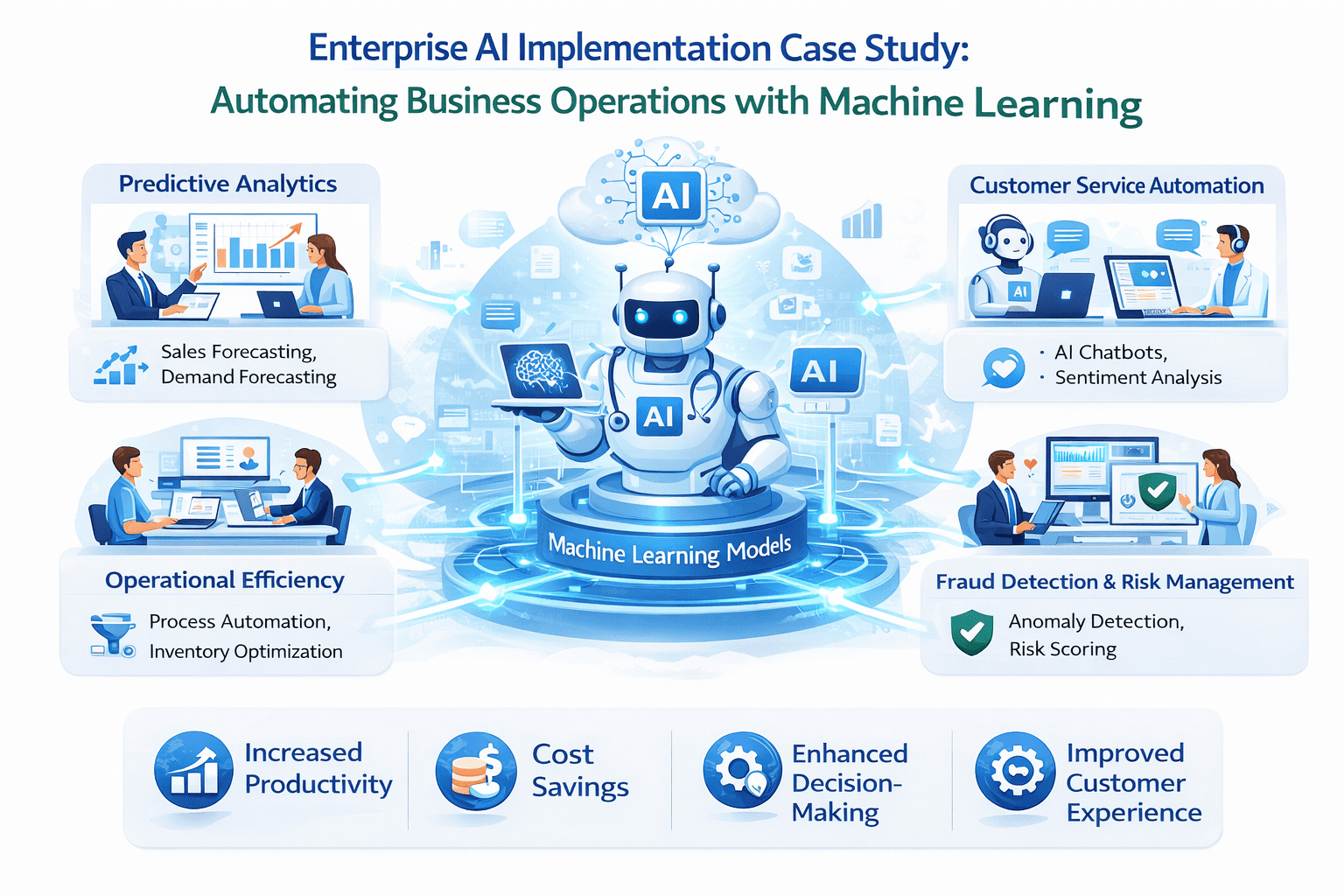
The Challenge
The client was a large enterprise managing complex, multi-department business operations across finance, operations, customer support, and supply chain. Many critical processes relied on manual workflows, static rule-based systems, and disconnected tools, resulting in inefficiencies and delayed decision-making.
Key challenges included:
High dependency on manual data processing and approvals
Slow turnaround times for operational and business decisions
Limited visibility into real-time business performance
Inconsistent data quality across departments
Difficulty scaling operations without increasing headcount
Growing pressure to modernize operations using AI
The enterprise needed a scalable, intelligent automation platform that could optimize operations while integrating seamlessly with existing systems.
The Solution
We delivered an end-to-end enterprise AI implementation, leveraging machine learning and cloud-native architecture to automate and optimize business workflows.
Key execution steps included:
Conducted an AI readiness assessment to identify high-impact automation opportunities
Designed a centralized data platform to unify enterprise data sources
Developed machine learning models for prediction, classification, and process optimization
Automated business workflows across departments using AI-driven decision engines
Implemented real-time analytics dashboards for operational insights and KPI tracking
Built a cloud-native microservices architecture for scalability and resilience
Integrated AI services with existing ERP, CRM, and internal business systems
Applied DevOps and DevSecOps practices to ensure secure, reliable deployments
Implemented monitoring, logging, and continuous model performance tracking
This approach ensured AI adoption delivered measurable business value, not just experimentation.
The Results
The enterprise AI implementation resulted in significant operational transformation and measurable efficiency gains.
Results achieved:
Automation of multiple core business processes
Faster decision-making through AI-driven insights
Reduced operational costs without increasing workforce size
Improved accuracy and consistency in business operations
Enhanced visibility into enterprise performance metrics
Scalable AI foundation supporting future innovation
Strong governance, security, and audit readiness
The organization now operates with a data-driven, AI-powered business model, enabling continuous optimization and competitive advantage.