The Challenge
The client operated a mission-critical Windows-based ERP application hosted on Amazon Elastic Beanstalk with Amazon RDS (MS SQL Server) as the backend database. As business usage increased, the platform began experiencing serious scalability, reliability, and performance issues.
Key challenges included:
Poor scalability during peak business hours
Limited control over auto-scaling behavior in Elastic Beanstalk
Inefficient load balancing, leading to uneven traffic distribution
Application slowdowns directly impacting end customers
Frequent performance degradation without clear root cause
No deep application-level monitoring or APM visibility
Limited observability into infrastructure and application health
Operational firefighting impacting business continuity
The ERP system was customer-facing and business-critical, so performance issues were directly affecting customer satisfaction and revenue.
The client needed a modern, scalable, and observable platform without rewriting the entire ERP application.
The Solution
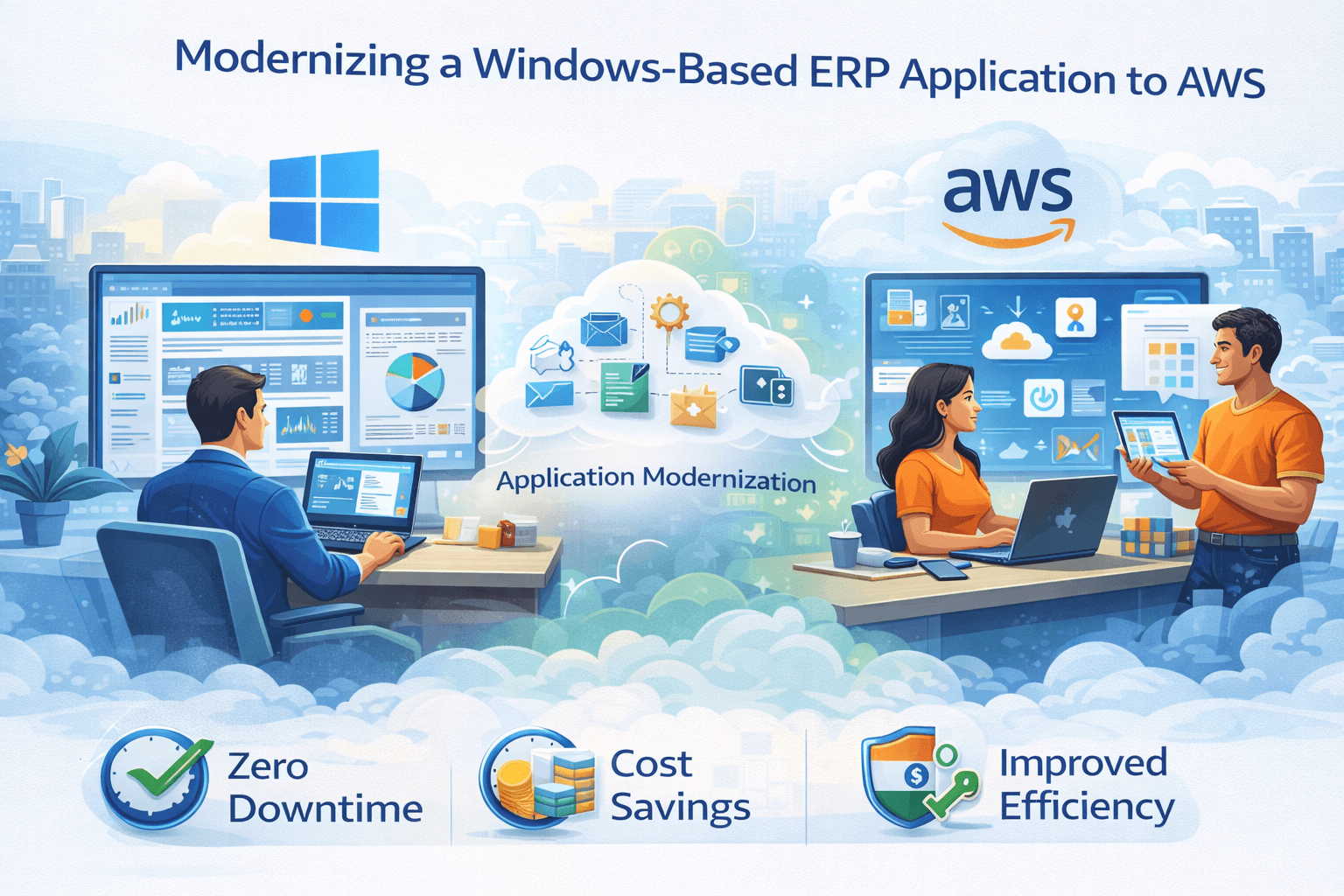
We designed and executed a phased ERP modernization strategy, migrating from Elastic Beanstalk to a containerized Kubernetes (Amazon EKS) platform, while keeping the Windows-based ERP application intact.
Key execution steps included:
🔹 Application Modernization (Without Rewriting ERP)
Containerized the Windows-based ERP application using Windows containers
Standardized application runtime environments for consistency
Enabled independent scaling of ERP services
🔹 Platform Migration: Elastic Beanstalk → Amazon EKS
Designed a production-grade Amazon EKS cluster
Migrated workloads from Elastic Beanstalk to Kubernetes
Implemented Kubernetes-native auto-scaling (HPA) for precise scaling control
Replaced legacy load balancing with:
Application Load Balancer
Kubernetes Ingress for intelligent traffic routing
🔹 Database Stability & Security
Retained Amazon RDS for MS SQL Server for data integrity
Tuned database performance and connection handling
Implemented IAM-based access control and secure connectivity
🔹 Identity & Access Management
Implemented IAM Roles for Service Accounts (IRSA)
Removed static credentials from application code
Enforced least-privilege access across ERP services
🔹 Observability & Monitoring (Major Gap Resolved)
To eliminate blind spots, we implemented full-stack observability:
Application Performance Monitoring (APM) to track:
API response times
Slow transactions
Bottlenecks inside ERP workflows
Infrastructure Monitoring using Prometheus & CloudWatch
Dashboards (Grafana) for real-time visibility
Centralized logging for faster troubleshooting
Proactive alerts for performance and availability issues
🔹 DevOps & Reliability Improvements
Infrastructure provisioned using Terraform (IaC)
Standardized deployment pipelines
Enabled rolling updates and zero-downtime releases
Reduced manual intervention and operational risk
The Results
The ERP modernization delivered immediate and measurable improvements across performance, stability, and customer experience.
Results achieved:
Significant improvement in ERP application performance
Eliminated customer-facing slowdowns during peak usage
Reliable and predictable auto-scaling behavior
Improved load distribution across application instances
Faster issue detection and root-cause analysis using APM
Reduced operational firefighting and downtime risk
Increased platform stability and customer satisfaction
Future-ready architecture supporting further modernization
The client now operates a modern, scalable, and observable ERP platform capable of supporting business growth without compromising customer experience.
Modernization doesn’t always mean rewriting applications.
By moving the platform from Elastic Beanstalk to Kubernetes, the ERP system gained scalability, resilience, and deep observability—without disrupting the business.