
The Challenge
The client operated a large-scale cloud environment supporting multiple business-critical applications across different teams and environments. The traditional perimeter-based security model could no longer protect the organization from credential theft, lateral movement, and insider threats.
Key challenges included:
Excessive permissions and lack of least-privilege access
Weak identity controls across users, workloads, and APIs
Limited visibility into access patterns and anomalous behavior
Inconsistent security policies across cloud environments
High number of unauthorized access attempts
Growing regulatory and audit pressure
The organization needed a modern, identity-centric security model that could continuously verify access and minimize attack surfaces.
The Solution
We designed and implemented a Zero Trust Cloud Security architecture focused on identity, verification, and continuous enforcement.
Key execution steps included:
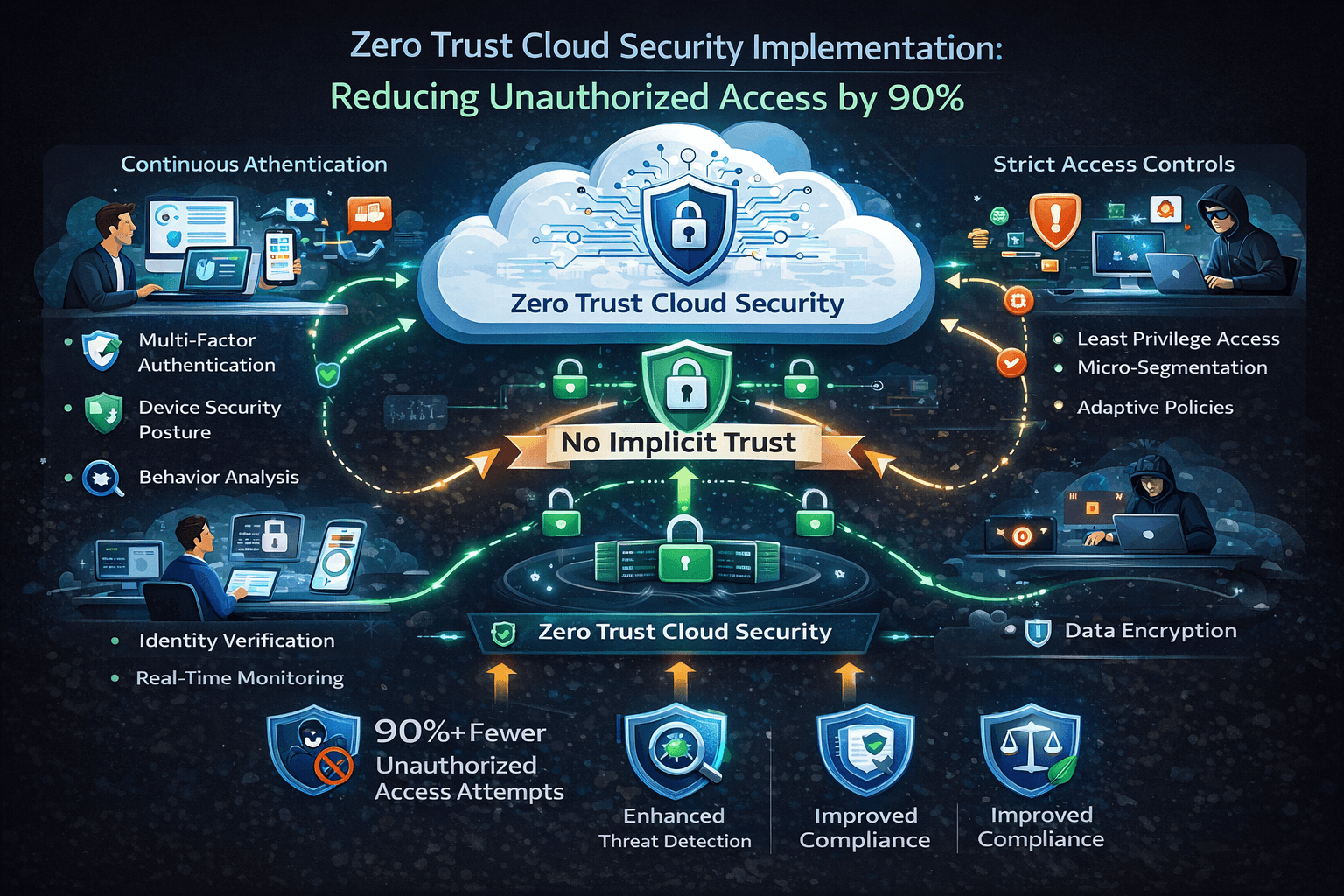
Implemented Zero Trust principles: “Never Trust, Always Verify”
Centralized identity management using SSO and enforced MFA for all users
Applied least-privilege access across cloud resources, APIs, and workloads
Segmented networks using private endpoints, micro-segmentation, and service-level policies
Secured Kubernetes workloads with mTLS, service mesh, and workload identity
Protected public-facing applications using WAF and DDoS mitigation
Encrypted secrets and sensitive data using centralized key management
Integrated logs and access events into SIEM and SOC platforms
Automated security policies using Infrastructure as Code
Embedded DevSecOps controls into CI/CD pipelines
This approach eliminated implicit trust and enforced continuous verification at every access point.
The Results
The Zero Trust implementation delivered measurable and sustained security improvements across the organization.
Results achieved:
90% reduction in unauthorized access attempts
Significant reduction in lateral movement risk
Improved visibility into user and workload behavior
Strong compliance posture and audit readiness
Faster detection and response to security incidents
Consistent security policies across cloud environments
Increased confidence from leadership and regulators
The organization now operates on a resilient, identity-driven security foundation, significantly reducing risk while enabling secure cloud scalability